
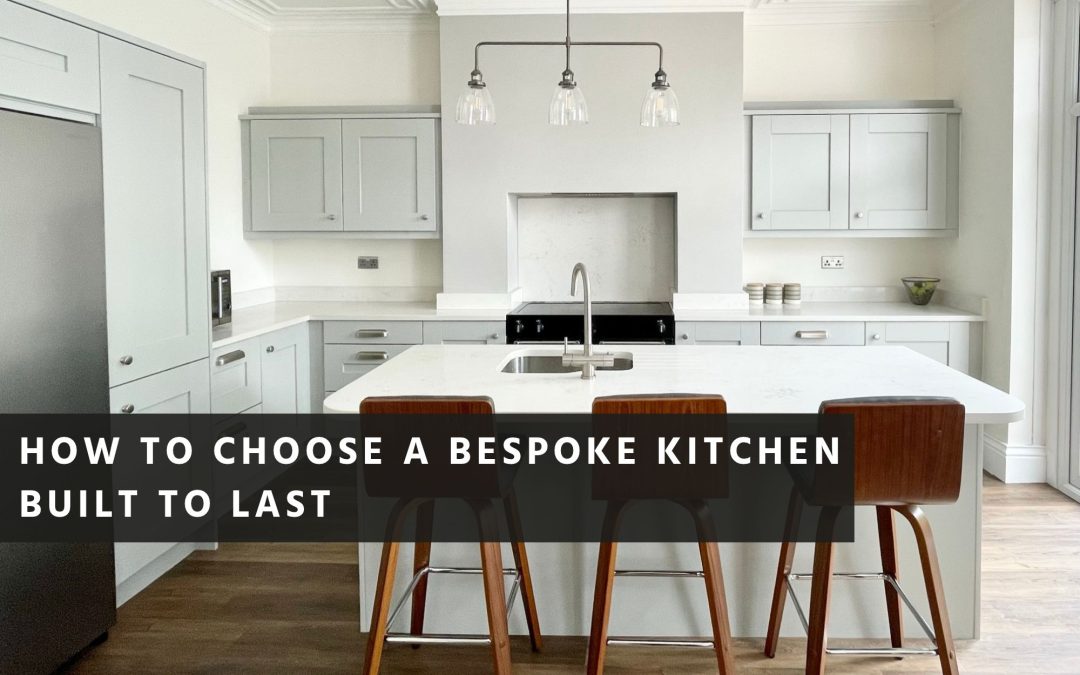
A kitchen that still feels right years after installation is rarely the result of one heroic material choice. It comes from a collection of less glamorous decisions: how the room is laid out, what happens at the sink, whether drawers are easy to use, and whether worn or damaged parts can be put right without remaking the whole space.
If you are planning a kitchen with the future years in mind, use that horizon to ask better questions. It is a useful brief, not a promise that any maker can give for every surface, fitting and household.
Start with the habits the room has to withstand
Consider the busiest hour, not just the finished photograph. Does someone need to get into the fridge while another is cooking? Where do wet dishes land? Is the bin close to food preparation, and can a large pan reach its storage without a struggle? A room that works with those habits is less likely to need its layout reconsidered after a few years.
Our made-to-measure kitchens are manufactured in the North East and designed around the people who will use them. That is the relevant advantage of a bespoke brief here: the dimensions, storage and finish can respond to the actual room rather than a standard arrangement of units.
Ask what happens around water and heat
At a sample appointment, it is easy to spend all the time on door colour and worktops. Look behind the door as well. Ask what the cabinet is made from, how exposed edges and joints are protected, and how the area around the sink and dishwasher will be installed. Water finding an unfinished edge can damage many kinds of board or timber; a material name alone cannot tell you how the complete cabinet will behave.
Our kitchen options include 18mm fully rigid cabinetry, Blum soft-closing hinges and drawer boxes. We can show you what a proposed design includes and discuss how its cabinets will be fitted and protected around the sink and dishwasher.
Choose a worktop for the cooking and cleaning you do. Different stones, composites and other surfaces have different care requirements and tolerances. Ask about sealing, hot pans, stains and repair before deciding which finish you like best. The questions are explored in our guide to choosing a kitchen worktop.
Look at drawers and doors in motion
A drawer may be opened several times a day, often while carrying more than expected. Test the sample loaded if you can. Does it feel steady near full extension? Can the runner be adjusted or replaced? The same goes for hinges, particularly on large, frequently used doors.
Testing by a component manufacturer is useful evidence for that component. For example, Blum says it tests its hinges through 200,000 opening and closing cycles. That is a hinge test, not a guarantee for an entire kitchen. Check which hardware your design includes and whether parts can be adjusted or replaced. Ask for the proposed specification and how parts would be serviced.
Choose a beautiful look you will want to keep
“Timeless” does not have to mean plain, pale or stripped of character. A strong colour might suit your home and still be a choice you enjoy years later. If you are uncertain, consider which elements would be hardest to change and which can be refreshed independently. Proportions, circulation and the main cabinetry do more long-term work than a passing decorative detail.
Talk through how finishes age in the real space. Natural timber can gain character, but it also responds to moisture and movement. Painted surfaces can often be refreshed, but the ease of that work depends on the finish and construction. No one material is the durable answer for every kitchen.
Make the long-term brief part of the first conversation
Ask the designer to show you the decisions that sit behind the visible result: cabinet construction, protection around wet areas, hardware, fitting and the choices available if something needs attention later. Then weigh those against the way the room should feel to you now.
A kitchen built to last is one you can keep using and enjoying, not a room frozen in a particular style. Bring the daily frustrations of your current kitchen to us. Our kitchen design and installation service starts with the room you have and the way you want to use it.