
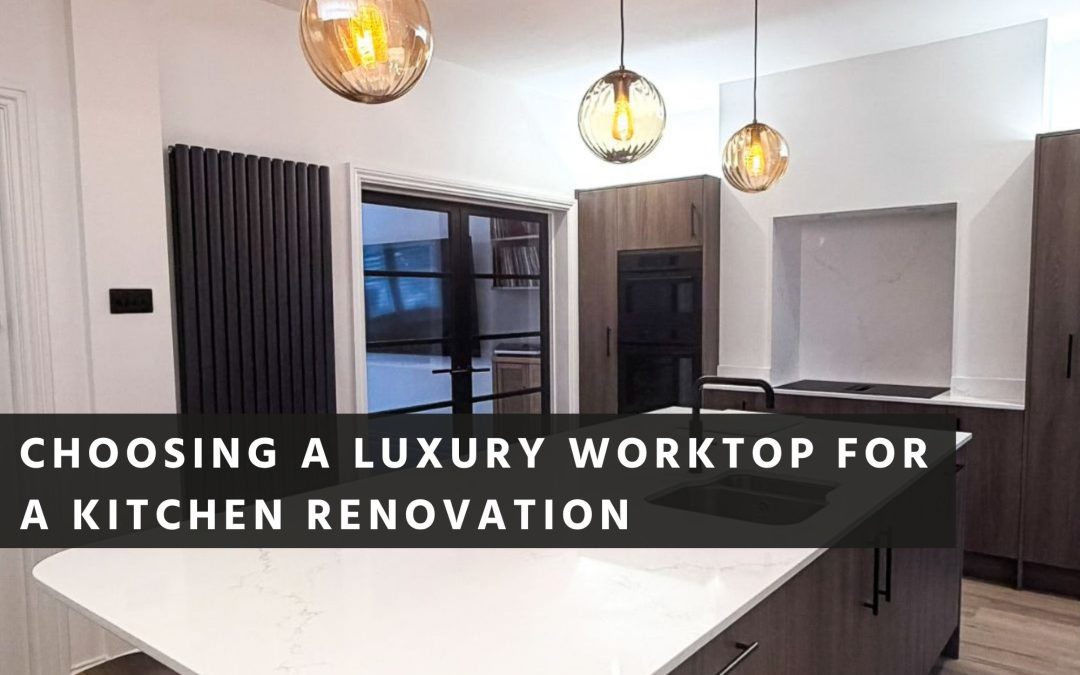
The worktop is the surface you live with. It’s what catches the morning light over coffee, what guests rest a glass on, what carries the weight of every meal you make. In most kitchens, it’s the largest single visible surface in the room. It sets the tone for everything else, from the cabinetry colour to the way the whole space feels to use.
A luxury worktop is less about picking the most expensive stone than choosing the material, finish and profile that suit the room you’re trying to create. It also needs to suit the life you’re going to lead in it.
We work through that decision early in every kitchen we design, because the worktop quietly shapes every other choice that follows. We design and install bespoke kitchen projects across Newcastle, Northumberland and Tyne and Wear. Because of that, the worktop conversation is one of the first we sit down to have.
Luxury worktop materials that suit how you live
The right material has more to do with how the kitchen will be used than how it photographs.
Quartz is engineered to feel calm and consistent. The colour and pattern run evenly across the slab. This makes it sit beautifully across a long island or an L-shaped run. It’s non-porous, doesn’t need sealing, and lives easily with family life. Coffee spills, children, the everyday business of a busy household. As a result, quartz tends to suit homes where the kitchen earns its keep every day and needs to keep looking the way it did on day one.
In contrast, granite is something else entirely. It’s natural stone, so every slab has its own personality, with depths and movements you can’t replicate. It handles heat better than quartz and develops a quiet character over time that some clients prefer. However, the trade-off is that it asks for a little more from you in return: occasional sealing, and the patience to view the actual slab before it’s cut, because no two are the same.
Beyond those two, there are quieter options worth considering. Sintered stones like Dekton and Neolith give you a thinner, more uniform line with strong heat and scratch resistance. They suit handleless designs well, especially where the worktop should feel light. Marble remains a beloved choice for islands and feature areas, though it’s a material that asks to be lived with rather than protected. It will mark and patina over the years, and for the right client that’s part of its appeal.
For anyone weighing granite and quartz specifically, our piece on granite vs quartz in more detail goes deeper into the comparison.
The finish changes everything
People often arrive at the worktop conversation thinking only about colour. However, the finish, meaning how the surface catches light and how it feels under your hand, usually matters more.
A polished finish is the version most people picture. High-gloss, reflective, the veining at its most vivid. It looks beautiful in photography and in showrooms, though it does ask you to live carefully with it. Fingerprints and water marks show more readily.
A honed finish takes the same stone and quietens it. Smooth, matte, no reflection. The room reads softer and more grounded, and the worktop steps back rather than competing for attention. It’s the choice for kitchens where the whole design wants to feel calm.
A leathered finish is the one that surprises people in person. It feels slightly textured, gently dimpled, and has a tactile warmth that no sample tile and no photograph quite captures. Leathered granite in particular has a depth and an ease to it that turns the worktop into something you want to run your hand across. It also hides fingerprints and water marks well, which makes it remarkably forgiving in everyday use.
We always encourage clients to feel the finish in person before deciding. A 100mm sample doesn’t tell you how a leathered slab will read across a three-metre island in your own light.
Thickness and edge: the quiet decisions
Worktop thickness is part structural, part aesthetic. Most luxury stone comes in either 20mm or 30mm.
A 20mm slab gives a thinner, more contemporary line. It suits handleless kitchens and rooms where the worktop should feel precise and almost weightless. A 30mm slab carries more visual presence. It tends to suit shaker or in-frame kitchens where the cabinetry itself has more weight.
Edge profiles do more work than people expect. A simple square edge with a softened arris reads cleanest. A pencil round adds warmth without sacrificing precision. A mitred edge, where two slabs join at 45 degrees to give the appearance of solid 60mm stone, creates a quietly dramatic island without the cost or weight of true thick stone. It’s the kind of detail that pulls the whole room together.
These choices also affect how the worktop meets the cabinetry. We resolve details like the edge against a handleless rail, or how it sits above an in-frame detail, at the drawing board rather than on site.
How the worktop affects the rest of the room
The worktop is rarely a standalone decision. It influences the splashback, the sink, the tap, and even how the cabinetry colour reads in the room.
A worktop with strong veining wants a quieter splashback that lets the stone do the talking. A calm, uniform quartz can carry a bolder splashback, or even a full-height stone run behind the hob, without the room feeling busy. An undermount sink leaves the stone edge fully exposed, so the edge has to be finished beautifully. Hob cutouts on an island also affect the structural integrity of the slab and need proper support underneath. That support needs to be detailed early enough, so nothing visible has to compromise the finished kitchen.
If you’re also weighing up smart kitchen appliances or clever kitchen storage, it’s worth thinking about those alongside the worktop. Pop-up sockets, drainage grooves, appliance cutouts, all of it gets templated into the stone before fabrication.
Why the worktop belongs at the start of the conversation
Your installer templates the stone after the cabinetry goes in. However, the decision about material, thickness and edge has to be made long before that, because almost everything underneath the stone is shaped by it. Cabinet depth, support structure, the position of every cutout, these all flow from the worktop specification.
When the worktop is left until late, small compromises start to creep in. The edge profile not quite suiting the door style. The slab thickness reading slightly off against the cabinetry. A hob cutout landing too close to a joint. None of these are dramatic, but together they pull the room down a notch from where it could have been. Bringing the worktop into the conversation early is how you avoid that quiet drift.
If you’re planning a kitchen renovation and want help choosing a worktop that suits both the room and the way you live, explore our bespoke kitchen design and installation service to see how we bring material, layout and craft together from the very start.