
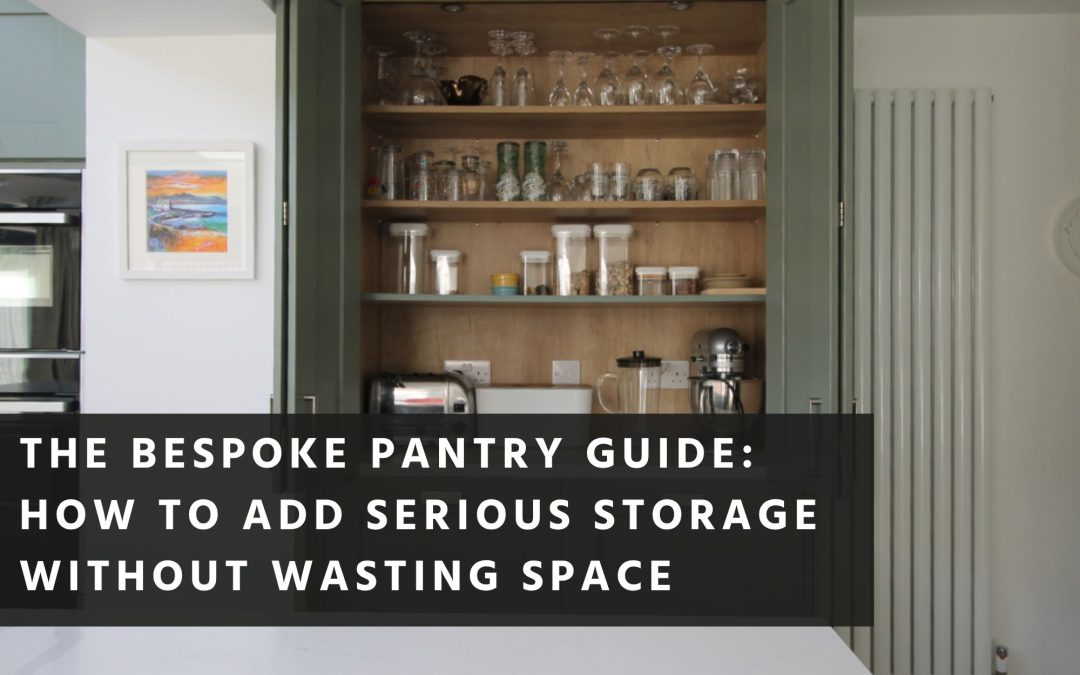
A bespoke pantry is one of the smartest ways to add storage to a kitchen without losing valuable space elsewhere. Designed around the exact dimensions of the room and the way a household shops, cooks and stores food, it can take the form of a fitted pantry cupboard, a full-height larder cupboard or even a compact walk-in pantry created from an awkward corner or unused adjoining space.
We design and install bespoke pantries as part of our bespoke kitchen projects across Newcastle, Northumberland and Tyne and Wear. Whether the aim is to keep worktops clearer, organise a busy family kitchen or build in better pantry storage from the outset, the principle is the same: every shelf, drawer and internal detail should earn its place.
Pantry, larder or butler’s pantry: what is the difference?
The terms get used interchangeably, but they originally meant different things and the distinction still matters when planning.
Larder cupboard
A larder was traditionally a cool storage space for perishable food, usually positioned on a north-facing wall or in a naturally cooler part of the house. A modern fitted larder cupboard takes the same principle and applies it to a tall, full-depth cabinet within the kitchen run. Ours typically include pull-out wire baskets, adjustable shelving at varying depths and sometimes a small internal worktop for decanting.
Pantry cupboard
A pantry was historically for dry goods, bread, preserves and crockery. In a modern kitchen, a pantry cupboard tends to be a double-door tall unit that opens to reveal tiered shelving, spice racks on the inside of the doors and dedicated zones for different categories of item. When the doors close, it reads as part of the surrounding cabinetry.
Butler’s pantry
A butler’s pantry is a separate working area, usually between the kitchen and a dining or entertaining space. It typically includes its own worktop, sink, additional storage and sometimes a second fridge or wine cooler. We have designed butler’s pantries as part of larger kitchen and fitted living space projects where the client wants a prep and clearing-up area that can be closed off from the main room, keeping the kitchen itself clear during and after entertaining.
What makes a bespoke pantry different from a standard unit?
The difference comes down to three things: dimensions, internals and integration.
Built to the room
A standard tall larder unit from a kitchen manufacturer comes in fixed widths and depths. In older properties across the North East, wall thicknesses, ceiling heights and floor levels vary enough that a standard unit rarely fits without filler panels or wasted space above. A bespoke pantry is built to the exact dimensions of the opening, which means the shelving runs the full width, the unit sits flush with the ceiling line and there are no dead gaps at the sides.
Internals designed around contents
Off-the-shelf larder cupboards come with evenly spaced shelves. A bespoke pantry can have shelves at different depths and heights depending on what goes where.
Taller sections for cereal boxes and oil bottles. Shallower shelves at eye level for spice jars and everyday ingredients. Pull-out drawers at the base for heavier items like bags of flour or tins. Door-mounted racks for smaller bottles and condiments. Every shelf position is set during the design stage based on a conversation about what actually needs to be stored.
Flush with the cabinetry
When a bespoke pantry is part of a fitted kitchen, the door fronts, handle spacing, colour and finish all match the surrounding joinery. There is no visual distinction between the pantry doors and the rest of the kitchen. The panel finish, grain direction and shadow gaps carry through so the storage disappears into the room rather than standing apart from it.
Walk-in pantries
A walk-in pantry does not need as much space as most people assume. In our experience, a footprint of roughly 1.2 metres by 1.8 metres is enough for shelving on two or three walls with a clear standing area in the centre. That is roughly the size of a small cupboard or the end section of a utility room.
The advantage of a walk-in is visibility. Everything is at eye level or within reach, arranged across open shelving rather than stacked behind a single door. It also creates a natural separation between the kitchen and the storage, which helps keep worktops clear.
From a fitting perspective, ventilation matters. A walk-in pantry stores ambient food in an enclosed space, so we factor in airflow during the design. That might mean a small vent to an external wall or simply ensuring the door is not fully sealed. Standard food safety guidance recommends storing dry food in cool, dry, well-ventilated conditions, which is straightforward to achieve with a bit of planning at the design stage. We have created walk-in pantries from unused corners, redundant hallway cupboards, sections of utility rooms and even under-stair storage areas that were previously dead space.
Pantry storage in smaller kitchens
Not every kitchen has room for a walk-in or a double-door larder. But a bespoke approach means pantry storage can be fitted into spaces that a standard unit cannot reach.
Pull-out tall larders
A single tall unit, sometimes as narrow as 300mm depending on the manufacturer, with pull-out internal shelving on both sides can hold a surprising amount. Because everything slides out towards you, nothing gets lost at the back. We fit these into gaps between appliance housings, at the end of a run or in narrow spaces beside a fridge.
Corner pantry solutions
Deep corner units are one of the most wasted spaces in a standard kitchen. A bespoke carousel or pull-out corner system can turn that dead zone into accessible, organised storage. The key is designing the internal mechanism around the specific angle and depth of the corner rather than forcing a standard fitting into it.
Integrated pantry within the cabinetry run
In some kitchens, the best approach is a section of the wall units dedicated to pantry storage, with deeper-than-standard shelving behind matched doors. From the outside it looks like any other section of the kitchen. Inside, it is laid out specifically for food storage with zones, varying shelf depths and door-mounted racks.
If you are weighing up different storage approaches, our guide to clever kitchen storage ideas covers some of the other options that work well alongside a pantry.
Getting the internal layout right
The internal layout is where a bespoke pantry earns its value. Getting it right starts with what actually needs to be stored rather than shelf positions.
We typically work through it with clients during the design stage by asking them to think about their weekly shop, their cooking habits and the items that currently have no proper home in the kitchen. That might include bulk dry goods, small appliances like a stand mixer or bread maker, serving dishes that only come out when entertaining, or everyday breakfast items that need to be accessible every morning.
From there, the shelf depths, drawer positions, pull-out trays and door-mounted storage are all set to suit. Adjustable shelving is worth including in at least part of the pantry so the layout can adapt over time as habits change.
The details that tend to make the biggest difference are small ones: a built-in power socket inside the pantry for charging a hand vac or running a coffee machine behind closed doors, LED strip lighting that comes on when the door opens, and shelf lips or retaining bars that stop jars sliding when a pull-out tray is extended.
Why the pantry decision belongs early in the design
A pantry works best when it is planned as part of the kitchen layout from the start. Trying to add one after the rest of the design is set usually means compromising on depth, position or internal access.
When we know early that a pantry is part of the brief, we can position it in relation to the main prep area, make sure the door swing does not conflict with other traffic routes, and design the internal layout around the storage that has been displaced from elsewhere in the kitchen. It also means the external doors, panels and handles can be ordered as part of the same cabinetry run, so the finish is consistent throughout.
If you are planning a new kitchen and want to explore how a bespoke pantry could work in your space, explore our bespoke kitchen design and installation service to see how we bring layout, storage and craftsmanship together from the outset.