
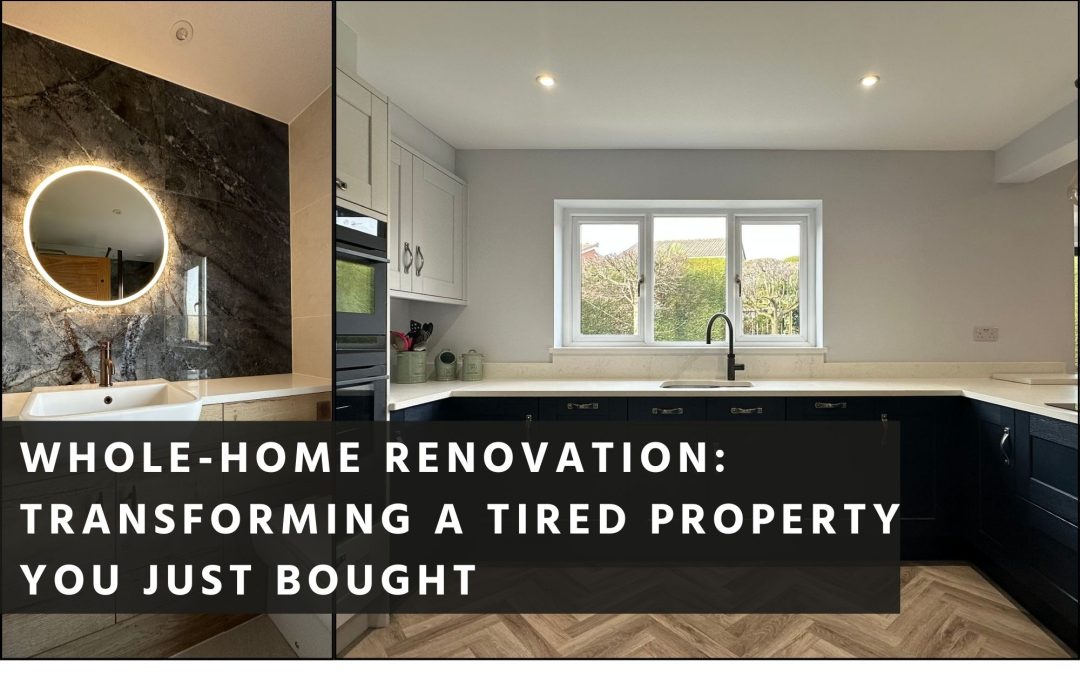
You’ve just bought a house that needs everything doing. The kitchen’s stuck in 1975, there’s one tiny bathroom for four bedrooms, and you’re standing in the hallway thinking ‘where do I even start?’ Every room screams for attention, you’ve got a renovation budget that needs stretching across kitchen, bathrooms and bedrooms, and the paralysis is real.
Here’s the framework: tackle services-first rooms (kitchen and bathrooms) before aesthetic rooms (bedrooms and living spaces), decide whether all-at-once or phased suits your budget and living situation, then allocate budget intelligently with kitchen as priority investment and contingency for surprises.
This guide walks through whole-home renovation planning specific to North East properties, covering sequencing frameworks, realistic timelines, and the critical choice between coordinating trades yourself or using a single design-to-completion team.
Where to Start When Everything Needs Doing
Start with the rooms that affect how you live daily, not the ones that look worst.
The services-first principle means prioritising kitchen and bathrooms over bedrooms, living rooms, or decorative updates. You use your kitchen and bathroom multiple times every day, their condition affects your quality of life immediately, and they’re structurally complex (plumbing, electrics, ventilation, building regulations). Getting these right creates a functional baseline for everything else.
Living in a house with a functioning kitchen and decent bathroom but dated bedrooms is manageable. Living in a beautifully decorated house where the boiler’s temperamental and the shower dribbles is miserable.
All-at-Once vs Phased Renovation: Which Approach Suits Your Situation?
This is the first major decision, and it hinges on three factors: budget availability, living arrangements, and disruption tolerance.
All-at-once renovation means tackling kitchen, bathrooms and bedrooms in one continuous project, typically 10–16 weeks. Advantages: lower overall cost (mobilisation happens once), faster completion, guaranteed design cohesion across all rooms, and one period of disruption instead of multiple phases. Challenges: requires full budget available immediately and tolerance for building site conditions.
Phased renovation means completing rooms sequentially, often with gaps between phases. Kitchen first, then bathrooms, then bedrooms, spaced over 6–18 months. Advantages: spreads cost over longer period, less simultaneous disruption, ability to learn from first phase before committing to next. Challenges: higher total cost (each phase has separate mobilisation), longer overall timeline, and harder to maintain design cohesion.
Choose all-at-once if: You have full budget available now, you can tolerate 12–16 weeks of intensive disruption, you want the house ‘done’ before moving in properly, or you value design cohesion highly.
Choose phased if: Budget needs spreading over 12–24 months, you’re already living in the house and can’t decamp for months, or you want flexibility in final specifications.
Most families renovating newly purchased properties in Newcastle and Northumberland choose all-at-once. The psychological relief of moving into a ‘finished’ house rather than a multi-year project is substantial.
The Services-First Sequencing Framework
For all-at-once projects:
Kitchen and utility room happen first, setting the material palette for the rest of the house. Main bathroom and ensuite follow immediately, sharing similar trades (plumber, electrician, tiler). Bedrooms come third because they’re simpler (no building regulations, less structural work). Living spaces and decorative work finish the project. Total timeline: 12–16 weeks.
For phased projects:
Phase 1: Kitchen (6–8 weeks) – where you spend most waking time. Phase 2: Main bathroom (4–5 weeks). Phase 3: Ensuite or second bathroom if needed. Phase 4: Bedrooms (3–4 weeks per room). Phase 5: Living spaces (variable).
This sequencing isn’t arbitrary. Plumbing and electrical work is disruptive and messy. Do it early whilst you’re tolerating disruption anyway, not after you’ve decorated the house beautifully. Structural work (removing walls, installing beams) affects multiple rooms, so coordinate it in phase one.
Budget Allocation Across Multiple Rooms
Think about budget allocation based on value and complexity, not equal distribution across rooms.
Kitchen takes the largest share – typically the most expensive single room combining bespoke joinery, appliances, worktops, plumbing, electrics, often structural work. This is your primary investment.
Bathrooms follow – particularly if you’re adding a second bathroom or updating multiple wet rooms. Two bathrooms together cost less than doing them separately.
Bedrooms receive what remains – fitted wardrobes, flooring, redecoration. These are simpler projects without building regulations or complex services.
Contingency is non-negotiable – set aside 10–15% for unexpected issues. Rotten floor joists, outdated wiring, asbestos removal, structural surprises appear in every renovation of properties over 40 years old.
Adjust based on priorities. If you’re serious cooks, weight budget towards kitchen. If you have young children and bathrooms are critical, prioritise those. The key is understanding that not all rooms cost the same or deliver equal value.
Common mistakes: underfunding contingency, equal allocation across rooms, and forgetting professional fees (building regulations approval, structural engineer, designer).
Timeline Expectations
For a typical three-bedroom North East property, expect 3–4 months for all-at-once approach, or up to 15 months for phased approach.
All-at-once projects move through design, strip-out, installation, and finishing in a continuous sequence. The first few weeks are the most disruptive (demolition, structural work, first-fix plumbing and electrics), followed by plastering, tiling, and fitting, then finishing with worktops, decoration and snagging. Always add buffer time for structural discoveries, material delays, or specification changes.
Phased projects spread the same work over a longer calendar period with gaps between rooms. Kitchen comes first, then bathrooms, then bedrooms. The work itself takes similar time, but the gaps between phases (driven by budget availability or contractor scheduling) extend the total project to 12–15 months.
Living Arrangements During Renovation
Can you live in a house during full renovation? Yes, but it requires planning.
For all-at-once renovations: seal off one bedroom as clean retreat, use existing bathroom until final week, set up temporary kitchen (kettle, microwave, camping stove). Most families find 12 weeks manageable if they know the end date. Alternatively, move out completely (cleanest solution but adds cost) or partial occupation (live upstairs whilst downstairs renovated, then reverse).
For phased renovations, staying in the house is easier but prolonged. One room unusable at a time, but you’re living through sequential building projects for months.
Daily cleanup matters. Professional contractors clean and tidy every evening before leaving. This is the difference between tolerable disruption and living in chaos.
Single Team vs Multiple Contractors
Single team approach: One company provides design across all rooms, coordinates all trades, manages Building Control, and takes responsibility for the finished result.
Advantages: design cohesion, efficient trade sequencing, single-point accountability.
Multiple contractor approach: You hire separate specialists and coordinate everything yourself. Potential cost saving, but you’re project managing full-time. Design cohesion becomes your problem, trade sequencing errors cause delays, and finger-pointing happens when something goes wrong.
The hidden cost of DIY coordination is your time and stress. Over 20 years coordinating whole-home renovations across Newcastle, Northumberland and Tyne and Wear, single-team projects consistently finish faster with better design cohesion. Design-to-completion service means one phone number and single point of contact throughout.
Design Cohesion: Creating a Unified Vision
Choose a consistent material palette across all rooms. Kitchen worktop stone echoes bathroom vanity stone. Kitchen cabinet colour picks up accent colour from bedroom wardrobes. Small material decisions made consistently create coherence.
Apply one metalwork finish throughout (brushed nickel, polished chrome, matt black, or brushed brass) to kitchen taps, bathroom taps, shower fixtures, door handles, and cabinet knobs. Mixing metallic finishes looks uncoordinated.
Phased renovations risk design drift. Your ‘perfect’ kitchen colour in February might look dated by August when choosing bathroom tiles. Solution: make all material and colour decisions upfront before any phase starts, even if implementation happens over months.
Making Whole-Home Renovation Work
Transforming a tired property is achievable with clear framework: prioritise services (kitchen and bathrooms) before aesthetics, decide all-at-once or phased based on budget and tolerance for disruption, allocate budget based on value not equal distribution, and either commit to managing multiple trades yourself or use a design-to-completion team.
The paralysis most people feel standing in that dated hallway comes from seeing everything at once. Break it into sequenced decisions. Which rooms affect daily life most? Kitchen and bathrooms. Which approach suits your cashflow? All-at-once if you have budget now, phased if you need to spread cost. Who coordinates the work? You if you have time and experience, or a single team if you value design cohesion and your sanity.
For whole-home renovation projects across Newcastle, Northumberland and Tyne and Wear, Kevin Richardson Bespoke coordinates kitchen, bathroom and bedroom renovations under a single design-to-completion service, managing all trades, handling Building Control approval, and delivering cohesive design across all rooms.