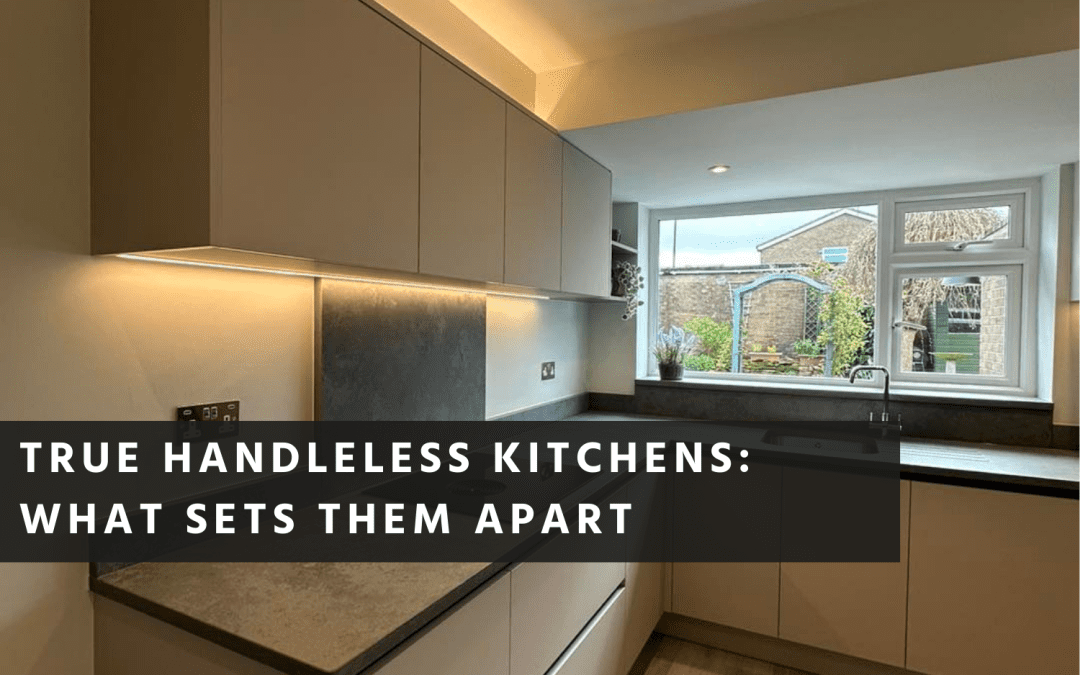
A true handleless kitchen offers a sleek, modern look that’s easier to clean and use than traditional kitchens with handles. If you’re researching handleless designs for your Newcastle, Northumberland, or Tyne and Wear home, you’ll quickly discover there are different types of handleless systems, and they’re not all the same. This guide explains what makes a kitchen truly handleless versus more affordable “handleless-style” options like J-pull doors or push-to-open mechanisms, when handleless makes sense for family kitchens, and what to look for when you’re comparing quotes.
What Is a True Handleless Kitchen?
A true handleless kitchen uses a continuous rail or channel built into the cabinet, just behind the door or drawer front. You open the door by reaching into that recessed channel along the top or bottom edge and pulling the front forward, rather than pulling a separate handle. The result is a smooth, continuous surface with no protruding hardware and no visible fixings.
This is different from other “handleless-style” alternatives. J-pull doors have a slim, J-shaped groove cut into the top or bottom of the door itself, so you hook your fingers into that groove to open it. Push-to-open systems use spring mechanisms inside the cabinet; you push the door and it pops open.
True handleless gives you the clean, minimal look without dozens of individual handles breaking up the run of doors and drawers. The continuous rail is easy to wipe down, and there are fewer visible fixings to tarnish, date, or collect grime.If you’re considering handleless for your home, it’s worth understanding these differences before comparing quotes. At Kevin Richardson Bespoke, we design and install bespoke kitchens across Newcastle, Northumberland, and Tyne and Wear, including true handleless systems with custom sizing and anti-fingerprint finishes manufactured locally in the North East.
Why Choose True Handleless Kitchens?
If you’re considering handleless for your kitchen, here are the main reasons homeowners choose this design over traditional handles or J-pull alternatives.
Clean, modern aesthetic
True handleless creates a smooth, continuous run of doors and drawers with no protruding hardware breaking up the lines. The look is minimal and uncluttered, which suits both contemporary new-builds and period properties where you want a fresh, updated feel without overwhelming the space.
Easier to clean and maintain
You’re wiping flat door fronts and a smooth rail channel, rather than scrubbing around dozens of individual handles, screw points, or decorative grooves. For kitchens that get used daily, this genuinely saves time on weekly cleaning.
No snagging or catching
Handles catch on clothing, bag straps, and pockets constantly in a busy kitchen. True handleless eliminates this frustration entirely. You move freely without catching yourself on cupboards, and you can open drawers with your hip when your hands are full.
Timeless design that won’t date
Unlike coloured handles (brass, copper, gold) that can look trendy within a few years, or ornate knobs tied to a specific era, handleless design is inherently neutral. The focus stays on your colour choices and materials, not the hardware. When you refresh the kitchen in five or ten years, you’re updating worktops and lighting, not replacing dated handles.
Better traffic flow in compact spaces
With no handles protruding 30-40mm from the door fronts, you gain usable space in narrow kitchens or galley layouts. This matters more than you’d think in terraced houses or small extensions where every centimetre counts.
Family-friendly and practical
Many handleless systems can be specified with anti-fingerprint finishes that resist smudges and marks far better than standard surfaces. There are also no sharp handle edges for children to bump into, and no small parts that can work loose or break over time.
True handleless isn’t the cheapest option upfront, but the combination of ease of use, low maintenance, and longevity makes it a sensible choice for homeowners planning to stay in their property for several years.
What to Look for When Choosing Handleless
If you’ve decided handleless is right for you, here’s what to consider when comparing options and quotes.
Custom Sizing vs Standard Units
Some kitchen companies offer handleless doors in fixed sizes (500mm, 600mm, 800mm widths). This works fine for straightforward layouts, but if your kitchen has awkward wall lengths, alcoves, or period features like chimney breasts, you’ll end up with filler panels or visible gaps. Bespoke manufacturers can make doors to exact widths, so you get a wall-to-wall finish with no compromises. This matters more in older properties where walls rarely measure in neat increments.
Mixing Handleless with Other Styles
You don’t have to choose handleless for every cupboard. Many people use handleless for wall units and tall cabinets (clean, modern look), then add shaker or in-frame doors to the island or base units for warmth and character. Or handleless for the main kitchen with traditional doors for a pantry or utility room. The key is making sure the handleless profile is subtle enough that it doesn’t fight with other door styles if you’re mixing.
Handleless Colours and Finishes
Handleless works in any colour, from ultra-matt whites and soft greys to deep greens, navy, charcoal, and textured wood-effect finishes. Here’s what to consider.
Light Colours for Darker Rooms
If your kitchen doesn’t get much natural light (north-facing, or a back extension with limited windows), light colours – soft white, pale grey, warm off-white – help reflect what light you do have. Handleless in light tones keeps the space feeling open without the visual weight of handles breaking up the smooth surfaces.
Dark Colours for Character
Handleless doesn’t have to look clinical or cold. Deep colours like dark green, navy, or charcoal work beautifully when paired with natural materials, brass or gold taps, wooden worktops, or textured stone. The handleless profile keeps the look modern, whilst rich colours and natural materials add warmth. It’s a good balance if you want contemporary but not stark.
Textured Finishes
Wood-effect textured finishes give you the warmth of timber without the maintenance. Modern manufacturing can create grain, knots, and colour variation that looks convincingly real. If you want handleless but worry it’ll feel too smooth or artificial, textured finishes solve this.
Matt vs Gloss
Handleless works in both, but matt finishes are more practical for family kitchens. Gloss shows every fingerprint and smudge, even with anti-fingerprint coatings. If you love gloss, consider using it on wall units where hands rarely touch, and keeping base units and islands in matt.
True Handleless vs J-Pull vs Push to Open: What’s the Difference?
When you’re comparing handleless kitchen quotes, you’ll see different systems at different price points. Here’s what you’re actually getting.
J-Pull Systems
J-pull kitchen doors have a J-shaped groove carved into the top or bottom edge of the door. You curl your fingers into that groove to pull the door open. It gives a cleaner look than separate handles and is simpler, and often more affordable, to manufacture and install than a full true-handleless rail system. The trade-off is that the groove itself can collect grease and dust, and the look doesn’t have the same completely uninterrupted horizontal line you get with a rail running behind the doors.
True Handleless Systems
A true handleless kitchen uses a dedicated aluminium rail fitted to the cabinet to create a continuous channel behind the door and drawer fronts. The fronts remain completely flat, and the rail runs in a straight, uninterrupted line, which is why this style is associated with German-inspired modern kitchens. The rail is robust, easy to wipe, and there are no protruding knobs or bars to date the design.
If you’re getting quotes, ask specifically which system is being used. “Handleless” can mean either, and the price difference usually reflects the construction method and hardware, not just profit margin.
Push-to-Open Systems
Push-to-open doors and drawers use internal mechanisms that release when you press on the front. They create a very minimal look with no visible rail or handle, but they rely on precisely adjusted catches and hinges. In busy family kitchens they can be frustrating – doors can spring open if you lean against them, and the mechanisms may need more maintenance over time. They tend to work best on a few selected units rather than an entire kitchen.
Frequently Asked Questions
What is a true handleless kitchen?
A true handleless kitchen uses an integrated rail or channel built into the cabinet, just behind the door and drawer fronts. You grip that channel rather than a separate handle or a groove in the door, which creates the seamless, hardware-free look along the front of the kitchen.
Are handleless kitchens hard to open?
No. True handleless doors with integrated rail systems are actually very easy to open. You can grip the entire edge of the door or drawer front, giving you good leverage, and there’s no protruding handle to catch your fingers on, and no push-to-open mechanism to wear out. Good-quality systems are designed to work smoothly even when units are heavily loaded.
Do handleless kitchens show fingerprints?
Standard gloss or matt finishes show fingerprints on any kitchen. Kevin Richardson Bespoke offers anti-fingerprint PerfectSense finishes as part of their bespoke kitchen ranges, which can be specified on their modern and handleless designs manufactured here in the North East. Matt and textured finishes hide fingerprints better than gloss, and anti-fingerprint coatings make marks far easier to wipe away.
Can you mix handleless with shaker or other door styles?
Yes. Many of our clients choose handleless for wall units and tall cabinets, then add shaker, in-frame, or textured doors to the island or base units. True handleless works beautifully alongside other styles because the rail and profile are subtle and don’t dominate the design.
Is handleless more expensive than handled kitchens?
True handleless rail systems usually cost more than simple J-pull or standard handled kitchens because they use dedicated hardware and modified cabinets. However, once you factor in the cost of quality handles (£10–£40 each), a well-specified true handleless kitchen is comparable to many mid-to-high-end handled kitchens. Long term, there are fewer individual parts to replace, and the look stays current for longer.
Does handleless work in period properties?
Absolutely. Handleless in deep, rich colours (greens, navy, charcoal) paired with natural materials (leathered granite, wooden worktops, brass taps) creates a beautiful balance between modern and timeless. Many Victorian and Edwardian terrace projects use handleless precisely because it keeps the look fresh without fighting the period features.
Is Handleless Right for Your Kitchen?
Handleless kitchens work brilliantly in family homes where ease of use and cleaning matter as much as looks. If you’re planning a kitchen in Newcastle, Northumberland, or Tyne and Wear, it’s worth understanding the difference between true handleless and budget alternatives before you commit.
At Kevin Richardson Bespoke, we design and install bespoke kitchens with true handleless systems, traditional handles, or a mix of both, depending on what works best for your space and how you use your kitchen. We manufacture our own range locally in the North East, which means we can offer custom sizing for awkward layouts, anti-fingerprint finishes, and flexible designs that fit your actual room dimensions.
View our kitchen portfolio to see handleless projects across the region, or contact us to arrange a home consultation. We’ll discuss what you’re looking for, and explain honestly whether handleless makes sense for your kitchen, or whether another approach would work better.
Your kitchen should work as hard as it looks. The right design gets you both.